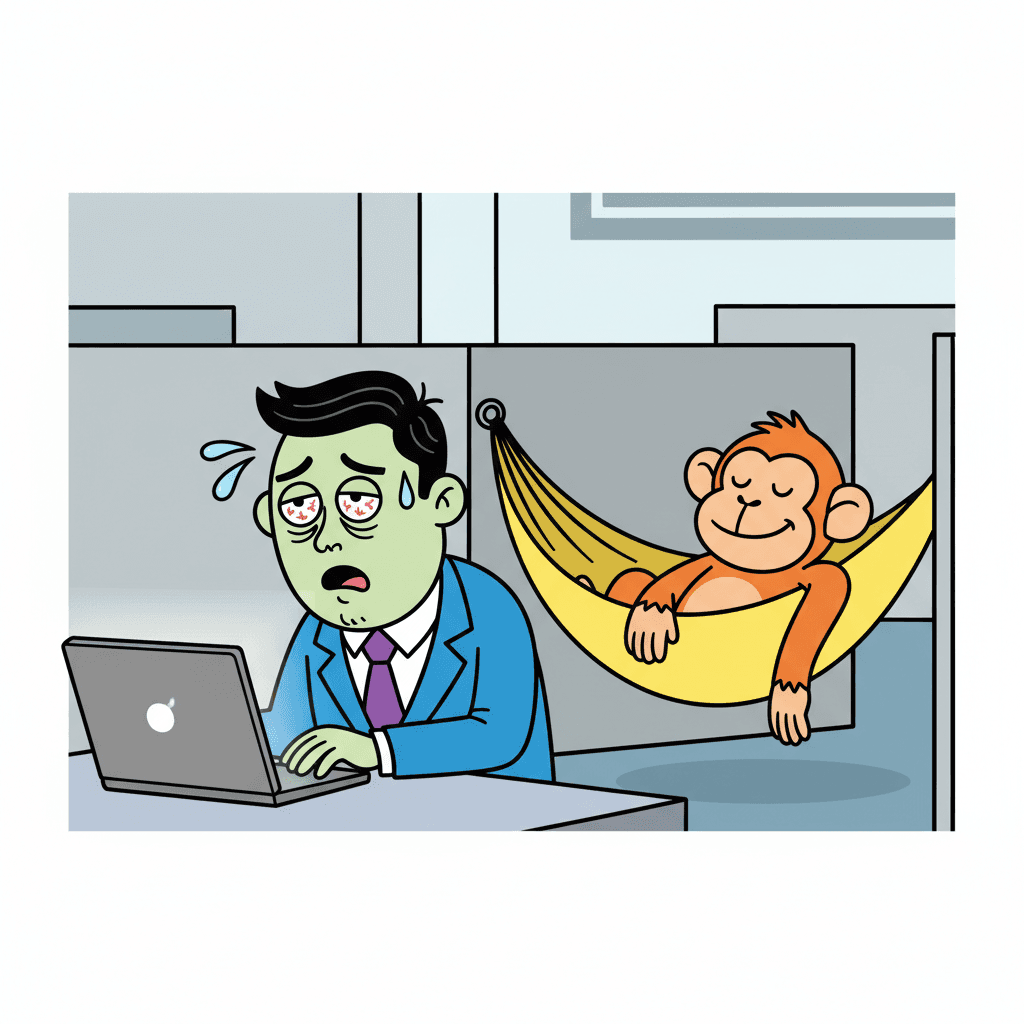
So We're Actually Sleeping Less Than Monkeys
Turns out, our 7 hours of sleep is the shortest of all primates, and scientists are calling it a “paradox.”
The Human Sleep What-Now?
You know that feeling when you finally crawl into your futon and manage, like, 6 or 7 hours? Feels pretty standard, maybe even a luxury on a weekday. Well, according to science, that's actually the shortest sleep time of *any* primate. Yeah, you heard me. Lemurs and monkeys sleeping on literal tree branches get more shut-eye than we do.
Researchers say that based on our big, energy-guzzling brains, we should be clocking in at around 9.5 hours a night. The huge gap between that and our actual 7 hours is what they've dubbed the “human sleep paradox.”
Quality Over Quantity, Apparently
The leading theory is that our ancestors got smart. Instead of sleeping with one eye open waiting for a predator, they started sleeping in groups, around fires, and in shelters. This created a level of safety other primates never had.
That safety allowed our sleep to evolve. We ditched the all-night series of light, nervous naps and went for one solid, deep, knockout session. Our sleep became incredibly efficient and dense. We pack way more of the good stuff—like REM sleep, for dreaming and processing the trauma of your morning commute—into a shorter amount of time.
So Am I Lazy or Just Evolved?
It’s kind of wild to think that we evolved to need *less* sleep, and yet I still feel like I could use about 12 more hours. Especially on a Monday after three highballs on Sunday.
So next time you see someone passed out on the Yamanote Line, don't judge. They're not just tired, they're experiencing a deep, evolutionarily efficient sleep cycle. 😴 Our 7 hours is basically the biological equivalent of a konbini onigiri: not exactly a feast, but incredibly efficient and it gets the job done. Tag a friend who needs to hear this is peak performance.
Sign in to keep your name & data